

What is the study about?
The modern world is moving toward a greener and more energy-efficient future. In this context, HVAC (Heating, Ventilation, and Air Conditioning) systems have become one of the key factors influencing (ideally reducing) both building energy consumption and indoor comfort. Achieving high indoor air quality while keeping energy consumption low requires a smart, well-considered approach - exactly what a 2024 study explored, with contributions from our Technical Director, Andris Krūmiņš.
Energy consumption in buildings: a challenge and an opportunity
HVAC systems quietly and steadily consume a huge portion of a building’s energy. And when they operate on an “always-on” basis, we not only pay for empty air but also contribute unnecessarily to heating the planet. Did you know that the building sector consumes more than a third of the world’s energy?
To tackle this issue, the study “Assessment of HVAC Performance and Savings in Office Buildings Using Data-Driven Method” analyzed a real office building with a constant air volume (CAV) ventilation system. Using data from the building management system (BMS) and simulation software, the researchers modeled various scenarios to optimize ventilation schedules, adjusting them according to actual occupancy patterns.

Key findings
- A data-driven and intelligently managed HVAC system can save up to 16% of energy while maintaining a high level of comfort.
- One of the most important steps is reducing or turning off ventilation when spaces are unoccupied (for example, at night or on weekends), while monitoring CO₂ levels to ensure air quality remains within acceptable limits.
- Although VAV (variable air volume) systems offer more flexible control, they are often not implemented due to high upfront costs. Simple adjustments to existing CAV systems can therefore provide a practical and effective intermediate solution.
- The study emphasizes the need to adapt HVAC schedules to actual building usage rather than running systems on a fixed timetable regardless of occupancy.
Why is it significant?
For office building managers and energy efficiency specialists, this data provides a clear path to improvement: there is no need to immediately implement expensive AI systems or completely replace ventilation systems. Initially, analyzing existing data and making simple optimizations is enough. This approach also helps cut greenhouse gas emissions and supports the European Union’s climate goals, including the target of climate neutrality by 2050.
What does this look like in practice?
Changes in energy consumption over a 24-hour period:

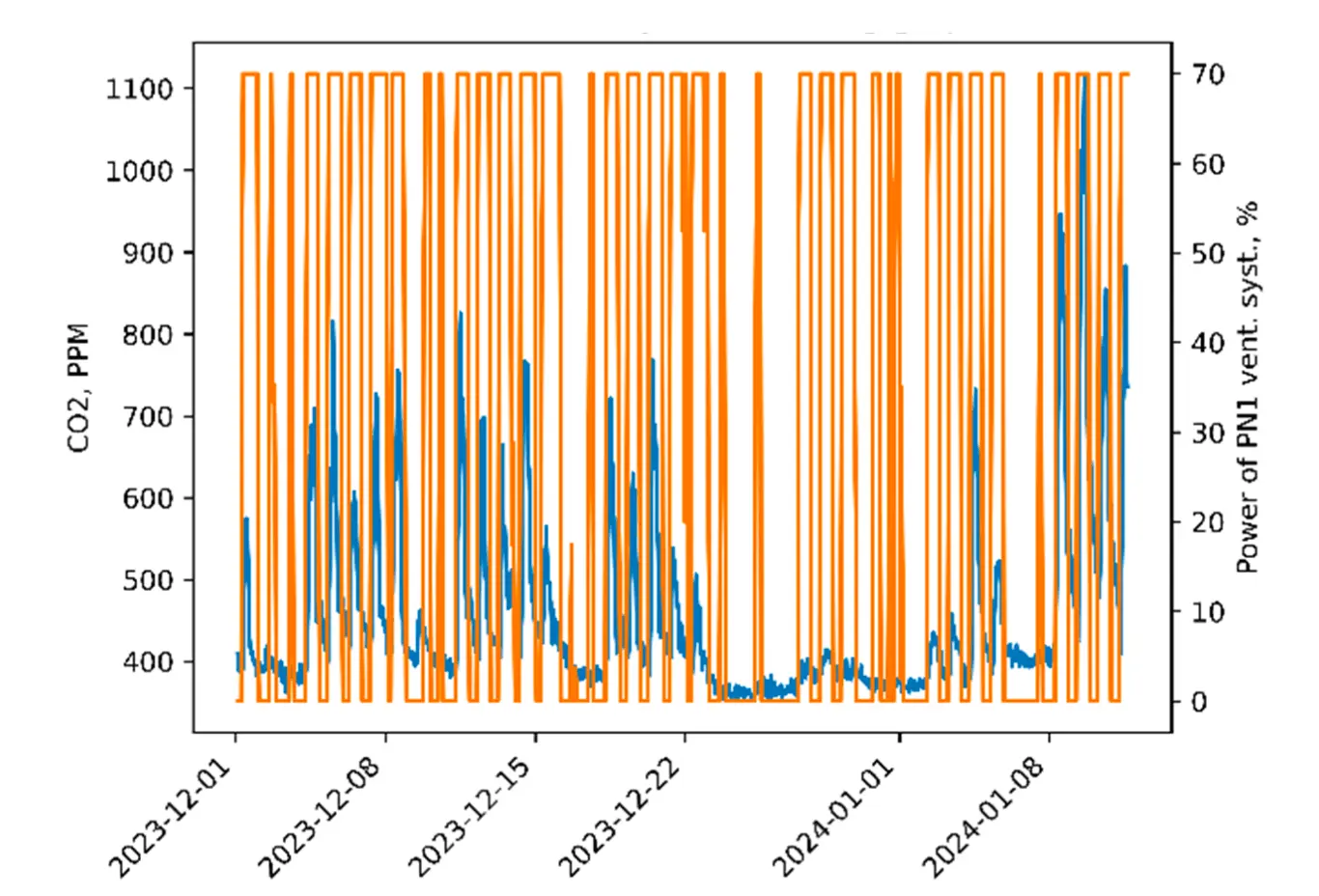
The chart illustrates CO₂ levels in a single office room (blue line) alongside the operating schedule of the ventilation system (orange line).
The CO₂ level is shown on the left axis (PPM), while ventilation intensity is shown on the right axis (%). The orange line indicates when the ventilation is on (for example, 70%) and when it is off (0%). The blue line reflects how CO₂ levels change based on occupancy and ventilation operation. The key observation: significant reductions are visible in the evenings and on weekends - times when the spaces are not actively used. When ventilation is turned off during these periods, CO₂ levels remain low because the rooms are unoccupied. This means ventilation can be safely switched off at these times, saving energy without compromising air quality.
The future? Even more intelligent - without necessarily adding more sensors.
This study represents an important step toward smarter building management, where data becomes the foundation for decision-making. In the future, we can expect even faster advancements - with sensor technologies, algorithms, and real-time automation capable not only of monitoring but also predicting and adjusting the environment as needed.
Yet even today, every step counts. Intelligent use of data and thoughtful building management deliver significant savings in both financial and natural resources.
Full study available here: https://www.mdpi.com/2829164
Stop paying for unused space. Let your HVAC work smarter and cut your energy bills.


.png)